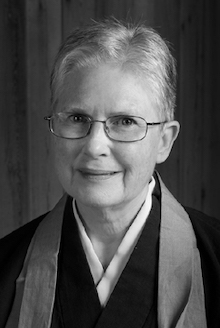
Effort in Practice |
In his book, You Have to Say Something, Katagiri Roshi said that generally we think of our actions in moral terms, as being good, bad or neutral. “But” he said, “in Buddhism, we think of actions as needing refinement. This is to view our actions in a way that is completely beyond our ideas of good or bad.” When we view what we say and do in terms of good and bad, it leads into rejecting ourselves based on these judgments. Whether we are proud or ashamed of what we do, both reinforce a self-centric view. Whereas viewing what we do as refined action implies that we’re in process—that our actions and responses are part of a wider, unfolding process. Using our intention to guide us, we simply continue making effort, walking the endless path of practice. Today, I would like to talk about the effort we make in practice. The Eight-fold Path refers to the practice or virtue of effort as “Right” effort, which I’ve also heard translated as perfected or completed effort; but I prefer fully embraced effort or fully engaged effort, or simply engagement. In Japanese Zen I think the term, “wholehearted,” or doing things with the whole body and whole mind, is the way this virtue is described and enacted. “Ordinary Mind is the Way” is Case 19 of the Mumonkan or Gateless Gate, a koan collection from China. It is directed to the effort we make in practice. This koan is an exchange between Joshu or Chao-chou who was about 20 at the time and had recently shifted from an intellectual pursuit of Buddhism to monastic practice with Master Nansen or Nan-chuan. The koan begins with Chao-chou asking: “What is the Way?” or “What is Tao?” Master Nan-chuan replied, “Ordinary mind is the Way.” Chao-chou asked, “Should I try to direct myself toward it?” Nan-chuan said, “If you try to direct yourself, you betray your own practice.” Chao-chou persisted, asking, “How can I know the Way if I don't direct myself?” Nan-chuan said, “The Way is not subject to knowing or not knowing. Knowing is delusion; not knowing is blankness. If you truly reach the genuine Way, you will find it as vast and boundless as outer space. How can this be discussed at the level of affirmation and negation?” With these words, Chao-chou had sudden realization. In this exchange, the young monk Chao-chou asked, “What is the Way,” meaning the Buddha Way, the way of practice and realization, or fundamental truth. Chao-chou was asking about the fundamental truth of Zen, and Nan-chuan’s answer “ordinary mind” actually referred to Original Mind, or consciousness before our usual thinking and conceptualizations are engaged. It’s important to understand that in this context Ordinary Mind does not mean consciousness, any way you happen to find it, or everyday mind with all of its thinking and other conditioned habits. It means mind-just-as-it-is unclouded by discriminating consciousness. This is the mind that is available in single-minded practice. When Chao-chou asked, “Should I try to direct myself toward it?” he is asking, how should I make effort in practice, how do I engage fundamental truth? Nan-chuan responded from the position of non-duality saying, “If you try to direct yourself, you betray your own practice.” By striving or reaching out toward something, we are already involved in discrimination, dividing the world into inside and outside, subject and object, desirable and undesirable, spiritual and mundane. When judgement and comparative thinking are functioning, Original Mind is obscured. When Chao-chou asked, “How can I know the Way if I don’t direct myself or if I don’t make effort?” Nan-chuan said, “The Way is not subject to knowing or not knowing. Knowing is delusion; not knowing is [refers to] blankness or total ignorance. If you truly reach the genuine Way, you will find it as vast and boundless as outer space.” Nan-chuan ended by saying, “How can this be discussed at the level of affirmation and negation, right and wrong?” With these words, Chao-chou had sudden realization. However, Mumon, who collected these cases, added, “Even though Chao-chou may be enlightened, he can truly get it only after practicing for 30 more years.” Here “30 years” is a metaphor meaning no fixed time or forever. Often practice is approached as a means to realization, or at least to a better experience, and later practice may become an expression of realization. While these may look the same, the attitude is different. It is common to think of enlightenment as the result of practice, but in Soto Zen, enlightenment is viewed as the starting point of practice. It’s actually the awakened quality of heart or mind that recognizes and enacts practice; and through practice, the awakened quality of mind may be actualized. Instead of talking about realization or enlightenment, Master Dogen used the words authenticate or verification to refer to this. And the unadorned, open, spacious quality of consciousness is always available; and through practice this consciousness can be enacted or made real in our lives. The function or usefulness of realization may be, as much as anything, to help us strengthen our resolve to practice, both for the liberation of ourselves and all beings. Directing ourselves to a goal, or making effort, and not making effort are opposites. One is defined by comparing it to the other. Not making effort can exist because effort exists. This is like all pairs of opposites—up and down, forward and backward, old and young, light and dark. Conceptually, opposites always arise together; you can’t have one without having the concept of the other. But Original Mind is outside the realm of opposites, it's neither thinking nor stopping thought, neither making effort nor taking it easy. Nan-chuan said, “Knowing is delusion and not-knowing is blankness.” In blankness, we tune out. In delusion, we automatically begin comparing and judging—interpreting and naming everything we encounter. Nan-chuan said the Way, or fundamental truth, is as vast and boundless as outer space—going far beyond our default of discriminating consciousness. Suzuki Roshi emphasized whole-hearted effort, undivided effort—throwing ourselves whole-heartedly into whatever we do with nothing extra, just pure effort, but it is important not to confuse this with being busy. I read an article in Lion’s Roar magazine by Charlotte Rotterdam called, “The Suffering of Busyness,” where she wrote, “A recent study found that busyness rivals wealth as a symbol of status in America.” So, now busyness has become a status symbol. She talked about this saying, “Our busyness keeps us from facing impermanence and uncertainty – the basic truths of our existence.” She talked about busyness as leading to the view, “I do; therefore, I am. I’m busy; therefore, I exist.” She said that she works with the question, “‘Could I just stop?’ Stop the dishes, emails, planning, and worrying? Can I rest in the now as it is?” I think this is a good example when no effort may be right effort, or when effort becomes letting go of making effort. Suzuki Roshi emphasized no-gaining mind in zazen, which means giving up trying to accomplish something or making it our possession or part of our identity. A question that’s frequently asked is, “If practice isn’t supposed to be goal-oriented, is any effort involved?” Sojun Roshi made the distinction between aspiration and gaining mind. He said, “Practice can only be done with a strong determination to do or to accomplish something, but the goal of practice is not the usual kind of accomplishment or goal. “The goal of practice is to let go of selfish [or self centered] desire, and to help ... beings accomplish the way.” He said, “Although we have our personal aspiration for enlightenment, the aspiration to save all beings comes first.... In our four bodhisattva vows we say, ‘Sentient beings are numberless, I vow to save them.’ He said, “Instead of making a beeline for enlightenment [for ourselves], we put the emphasis on saving beings. But enlightenment and saving all beings are not two different things.” (Wind Bell, Spring 1993) So, we need to develop a strong determination to practice, but the paradox is that what we practice is a kind of non-grasping or what has been called objectless effort. Clarifying our intention, connecting with our intention, provides the direction of our practice. Katagiri Roshi said, “the meaning of the Bodhisattva vow is to do what Buddha does, to help all sentient beings.” He said, “To take care of other beings is to take care of your life in its totality.” Our habits of mind require that we make a lot of effort throughout the day to be aware of what’s going on in our mind as we go through our day. We should know what we are thinking, what the content of our fantasies is, what the feeling is underneath it. The paradox is that our effort or determination is not directed toward a goal or object. Our direction is simply to wake up, to see our conditioning, our strategies, our nearly constant stream of thought for what it is and then to reconnect with our original, undivided mind, however briefly. Sometimes Buddhist practice is referred to as “cultivation of mind.” When I began meditating, I hoped that I would have some kind of mystical experience or that something special would happen, or that meditation would bring a deep peacefulness. This desire is a kind of spiritual materialism, the work of grasping mind. This is the usual way the mind works, reaching out for what it desires. So, in directing my meditation practice, I had only changed the object of my desire. In practice, we try to loosen the energy of grasping. Dogen wrote, “Realization, neither general nor particular, is effort without desire.” Looking at practice from another perspective, Katagiri Roshi said, that “...now is made manifest by the fact that when you meet something, it meets you. When you meet zazen, zazen meets you.” He said, “ ...[zazen] is the pure functioning of this moment.” For zazen to meet us, we have to be unequivocally open to zazen. Unequivocally means without reservation, without holding back so that some part of our mind can tune out or think about something else. Unequivocal means there is nothing else in that moment; at the same time, this moment includes all that we are experiencing, our breathing, sound, smell, taste, touch, as a totality, but without thinking about it, just experiencing it. Zen emphasizes wholehearted practice as a way to meet ourselves fully in this moment. Not only does practice have no stages in Zen, there is also no fixed teaching. When asked, “What is Buddha?”, Ma-tsu first taught “this very mind is Buddha;” and after his disciples adjusted to that, he taught, “Not mind, Not Buddha.” Dogen taught that just sitting is itself realization, that it is not necessary to recite sutras or do ceremonies. But he also developed forms for most of the mundane activities of monastic life such as bathing, using the toilet, brushing your teeth, and so on. We just about have to use language and concepts to teach, but the words only point us in a direction. Actual practice is encountered alone or directly, and, although we can receive suggestions about how to do it, we have to find it for ourselves. Most of us go about our practice by experimenting, doing too little and then trying harder; doing too much and then pulling back getting to know when we need to be strict with ourselves, and when we need to be gentle and, hopefully in the process, we find out how to nurture our practice. So, practice tends to be a kind of fine tuning to find just the right amount of effort, the right amount of constancy, while letting our intention guide us. But there are no objective markers to let us know when we are doing enough. In zazen, we are encouraged to sit upright and to be awake without moving. Just sitting with whatever arises, being still in the midst of our impulses to move, or in the midst of pain, is a good teacher. It shows us that we don’t have to move, we don’t have to act on our impulses. By being still, we can see the activity, the constant unnecessary activity of our mind and how this constant mental activity that we create acts like a cocoon insulating us from our immediate experience. I would like to read a dialogue written by David Weinberg, a disciple of Sojun Roshi, about how to make effort: One day a monk asked Sojun, “What is hard practice?” Sojun replied, “Not moving.” The monk said, “What is this not moving?” Sojun said, “In zazen it means don’t move. When your leg hurts, let the leg practice with its pain. If an impulse to get rid of the intensity occurs, notice this impulse but don’t react. However, if a sharp pain in the knee alerts you to danger, you may decide to adjust your posture. If so, simply mobilize awareness; adjust your posture carefully; do not indulge in justification or recrimination. This is not moving. “In everyday life, meet each situation on its own terms, freshly, wholeheartedly. Refrain from judging, rejecting, demanding, or reacting. For example, when a powerful emotion such as fear presents itself, do not deflect it, analyze it, excuse it, amplify it, suppress it, dismiss it or identify with it. Don’t cut yourself off. If necessary, take a deep breath, relax your abdomen and smooth your brow; but don’t bother to congratulate or console yourself. This is not moving. Thus, the not moving of zazen is continuous with the not moving of everyday life.” Then Sojun said, “A river flows; a mountain is still. The mountain’s stillness is its flowing. The river’s flowing is its stillness. “What is your stillness? Don’t move! A verse says, ‘Encountering spring for many years, the heart does not change.’ Master Bokusan said, “To sprout in spring is the heart that does not change. To bloom in spring is to abide at ease immovably.’” Sojun ended, “The heart is originally open. Zazen is the ceremony of everyday life, of being-as-is. Performing this ceremony, how could you move? How could you bind yourself?” (Berkeley Zen Center News, March 2001) When we move in zazen, we don’t get to know the stillness we share with everything. But sometimes in zazen, it works better to move, by just accepting and observing that impluse. Sometimes people have had injuries from pushing themselves too hard in zazen. So, we need to find a balance between pushing past our conditioning and being sensitive to our bodies. Sojun Roshi talked about practicing with our edge in zazen. In order to find our edge, sometimes we have to go past it. So if you find you’ve gone too far, pull back a little. It’s important to listen to your body. Not moving doesn’t mean to hold yourself still and ignore your body, it means to join your body in stillness and listen to it. Copyright © 2026 by Josho Pat Phelan |